Showing posts with label history. Show all posts

Tuesday, 21 June 2022

Some Dutch Cycling infrastructure is older than you might expect, some of it is newer

It sometimes not clear to people whether cycling infrastructure in the Netherlands is a new phenomena or something which has been around decades ago. Sometimes new infrastructure looks "old" or old infrastructure looks "new".

Old infrastructure which looks "new"
Here's an example of a cycle-path and road junction which look right up to date, but which have actually existed for over 60 years.

Parcels containing bike parts beginning their journey to customers. I use this cycle-path several times a week to transport goods like this because it's a main route from the suburb where we live and work into the centre of the city. Note the re-surfacing work being carried out on the other side of the road.

A photo of the same location from 2007 shows an older cycle-path surface and everything looked a bit worn out back then. Tiled surfaces were once quite common on Dutch cycle-paths, this one having survived well past when others had already been replaced. The asphalt came soon after this photo was taken. The cycle-path is in exactly the same location and has the same 2.5 m width, a width which is perfectly fine in most situations for a unidirectional cycle-path, though it would be too narrow if this was intended for bidirectional use.

In this aerial shot (courtesy of Bing Maps), the red arrow shows where my bike was when I took the photo above. You can clearly see the road layout here in which motorists give way to the cycle-path as well as pedestrians crossing the road. You can also see the crossings from left to right for cyclists and pedestrians. In that direction, across the main flow, cyclists do not have priority. I've no explanation for the strangely parked vans.

An aerial photo from 1961 shows almost exactly the same layout. The cycle-path is unchanged apart from the surface but the road from left to right has been reduced from a dual carriageway type arrangement to a normal road. When this photo was taken this was not part of a direct route into the city centre because a bridge a few hundred metres further along would not be built for a few more years. Both the bridge for access to the centre and the dual carriageway road arrangement were influenced by a 1913 plan to make a "harmonious" city. The bridge (the current version of which is visible in a recent video) is useful, but it's a very good thing that the idea of building a ring-road this close to the centre was abandoned. 

New infrastructure which required considerable work to look much as it used to
Someone who was transported through time from the 1940s might not initially notice, but it actually took a lot of work to give this road layout a similar appearance to 80 years ago:

This photo from 2022 shows what looks like a new cycle-path, and indeed it is relatively new, dating from 2008. To the right of the cycle-path is a separate pedestrian path, to the left there's space for car parking, then the road and a canal. Referring to older photos this initially looks like not much has changed. See the next photo.
This photo from the 1940s already showed the canal, the road, the cycle-path and the pedestrian path. But note that at that time the cycle-path and pedestrian path were both narrower, there was no car parking space and there was no substantive buffer between the road (which had a higher speed limit back then) and the cycle-path. When I took my photo I stood in almost the same position as this photographer stood in when he took his photo, but I'm on the cycle-path and he was on the road. The very similar appearance hides major work to create more space alongside a canal in order to enable us to have better cycling provision as well as car parking spaces required with the considerably higher car ownership rate of the present day.

This photo from 2007 facing in the opposite direction (note the same lit up bright red sign on the left) shows where the extra space for the wider cycle-path and car parking came from. The first 1.5 km of the canal running from the city centre to the East was shifted sideways, to the North, by about two metres. Everything was reconstructed from scratch, but the pedestrian and cycle-paths were replaced first and at this point we're cycling on a subsurface (note different colour asphalt from the finished cycle-path).

So in this case the infrastructure looks like nothing much has changed, but actually it took a lot of work to create a situation where the route looks much like it did in the 1940s while actually offering more to modern cyclists, pedestrians and drivers than was the case before.

New Infrastructure which looks "old"

One of the things which sometimes makes people think that something new is "old" is the road surface, or that streets seem to be very narrow. While tiles on cycle-paths along through routes have often been swapped out for asphalt, as shown above, in city centres the opposite has happened: asphalt is swapped for tiles.

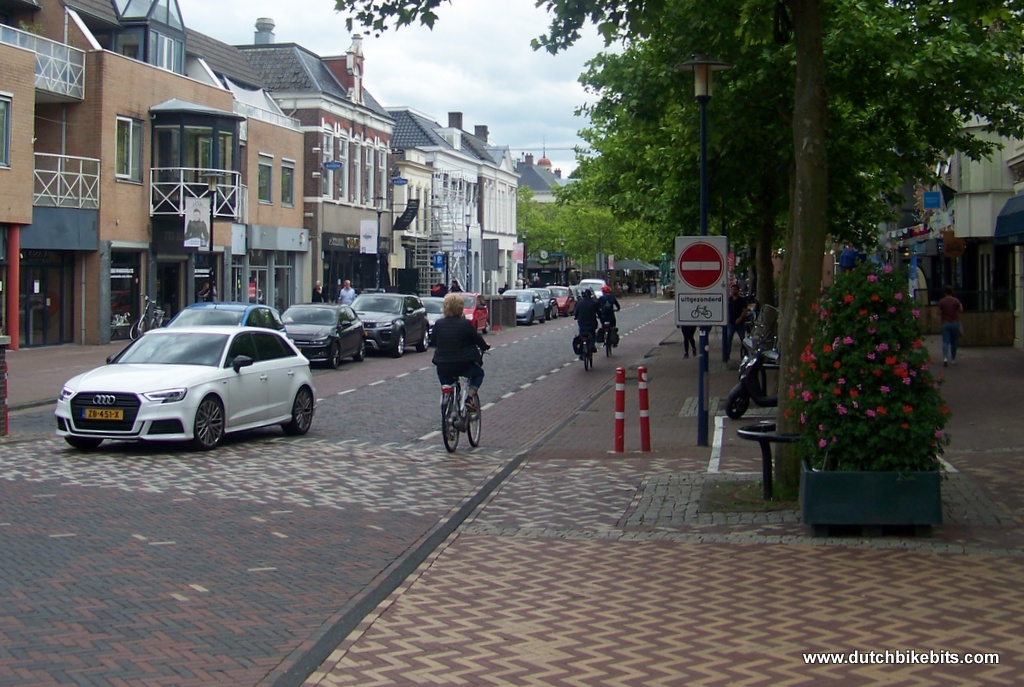
A city centre street in Assen. Drivers can access this road, but for them this is now a one-way detour to nowhere. No-one drives a car here unless they need to pick something up from one of the shops. This road surface is used by more cyclists than drivers and by bike this is a two way road which provides direct routes to many locations

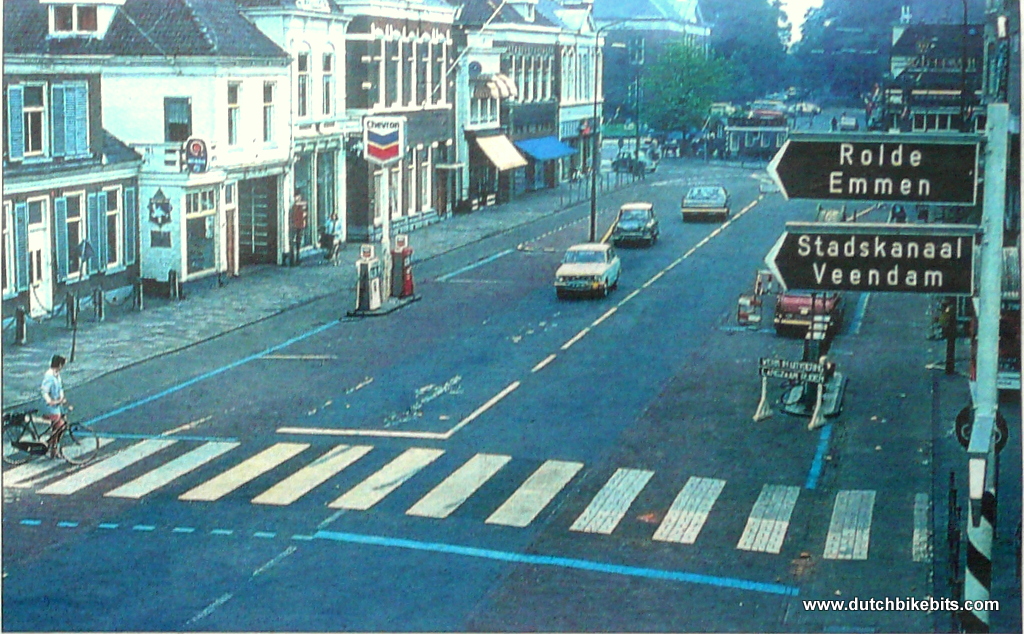
This is what the same place used to look like in the 1970s. At that time the street looked very wide and it was used as a major through route for cars, as you can see from the signage. Drivers were served by filling stations on both sides of the street. Pedestrians crossing the road had to walk a remarkably long walk to travel between the narrow sidewalks on either side. Asphalt in the middle of the street provided a good surface for driving cars and narrow cycle lanes as the edge provided an inferior surface for cycling. The photo isn't quite wide enough to show the traffic lights which were needed in this location, but which no longer exist. Absolutely no space could be found for trees. If this was still a main route by car in the 21st century it would have become an extremely unpleasant place.
Go back a little further in history and we find that the same street once looked like this. The current layout resembles an attempt to return to how this street looked before it was temporarily taken over by completely car oriented thinking. But what we see now is all completely new and accommodates customers visiting the shops by car, while also excluding the through traffic. Also notice that from the first photo right down to this one people are using similar designs of practical everyday bicycles. This near perfect design has never gone out of date because it works so well.

What can we learn from this
Initial impressions can be misleading. Sometimes what looks new is old, or what looks old is new.

The Netherlands had cycling infrastructure early in the 20th century, but this was not always valued and there are many examples of early cycling infrastructure being removed in the mid 20th century in order to provide more space for cars. There are also many historical examples of lacklustre infrastructure with inferior surfaces or which took longer routes than driving. It was not until the mid 1970s that the value of cycling infrastructure was recognised again after a series of protests, and it took until the 1980s until the necessity of a full grid of efficient go-everywhere infrastructure was acknowledged, after which quick progress was made.

Click for a more about how this city centre was transformed twice during the twentieth century, first to accommodate more cars and then to exclude them. There are also many more before and after photographs showing how Dutch roads changed over time.

Wednesday, 15 September 2021

Stop de Kindermoord revisited. Is New Zealand now outperforming the Netherlands ?

Back in 2011 I wrote about the success of the Stop De Kindermoord (Stop Child Murder) campaign in the Netherlands. This presumably had been covered by English language press in the distant past, but by 2011 it had been forgotten about so my blog post got quite a lot of attention at the time and encouraged other people to write their own versions of the same story.

The success of that campaign helped lead to improved safety for all Dutch cyclists, not only children. We would likely not have the excellent go-everywhere grid of cycle-paths that we have now if not for the success of that campaigning. That campaign and the realisation that the most important thing that can be done for cycling is building a grid literally changed the landscape in this country, however we can never be complacent. What has changed once can change again.

People often wonder why it is that the Netherlands succeeded in cycling when other countries did not. Why NL acted to reduce child deaths when other countries did not. I think it was largely a matter of luck. The Netherlands happened to have the right leader at the right time.

Dutch schools are open again. Thanks in large part to the work of politicians 40+ years ago, children are relatively safe from traffic. But thanks to the ineffective leadership of our current politicians they're not being protected against infection with Covid-19 (which is an issue for this reason).

The same thing can be observed now as we face a different health crisis and this time it's in reverse. Covid-19 has caused not just a little more death in the Netherlands than in New Zealand, but literally three orders of magnitude more deaths per capita. This enormous difference is the result of policy. It can't be explained away in a simple manner such as differences in climate, that NZ is an island, the culture etc. While in the 1970s the Netherlands had effective leadership which reversed child deaths, this time it is the Netherlands with an ineffective leader in the shape of Mark Rutte while New Zealand's Prime Minister Jacinda Ardern has been highly effective. As a result, thousands of lives have been saved in New Zealand relative to the outcome that we have here.

Forty years ago this cycle-path was part of my route to school in New Zealand. It was never a perfect example and while it still exists it won't work as well as it once did because it's been divided into pieces.

While the Stop De Kindermoord protests were taking place in the Netherlands I was a schoolchild in New Zealand. In this blog post I will be comparing the response of both of these countries to two crises. But if you're not from either country, read on because this piece is not only about those two countries. 

My approximate route to school in 1980 (Google
maps doesn't use the cycle-path under the roundabout)
New Zealand's schools keep children safe by closing with
a much lower rate of Covid-19 infection than here in NL.

The fervour for cycling infrastructure and creating liveable communities was not limited to the Netherlands in the 1970s but was also quite significant internationally. I wrote some time ago about a housing development near my old home in the UK, but another example is a cycle-path which ran almost all the way from my home in New Zealand to my secondary school. It wasn't a great cycle-path, giving way to cars at every junction, but it was there. Dutch infrastructure being built around the same time was more sophisticated. But the main thing that made the Dutch cycle-paths worthwhile in the end was that they eventually formed part of a complete go-everywhere grid of routes while what was built elsewhere usually stood alone so was of limited use. In the case of the cycle-path which I used to use, it's obviously less useful now than it used to be because many more homes have been built in the area, with many more roads connecting them, so while motor traffic has increased the cycle-path, which never had priority over side-roads, now gives way even more than it used to. This is just one example of how higher population density does not automatically improve cycling conditions.

It was quite common for young New Zealanders to cycle to school in the 1970s and early 80s, but 50 years of excluding cycling from planning has left cycling at a very low level. When I used to cycle to school in NZ there was cycle parking. These days my old school looks like a big car park, which is rather sad.

1970s politics in New Zealand and the Netherlands
New Zealand's prime minister during the Stop de Kindermoord period was Robert Muldoon. Muldoon became Prime Minister in 1975 as leader of the right wing National party after a campaign which included use of an absurd animated film to imply that the opposition's plans to provide pensions were communism. Other advertisements were criticised for stoking up racism against Polynesians. Muldoon's Wikipedia bio says he was "a bully" and "an enigma" and lists, amongst other things, his promising to "get tough" on immigration, arrests and deportations of Pacific Islanders (including the "Dawn Raids"), pushing of "law & order", causing an opposition leader to resign by accusing him of being homosexual (this lead to a police investigation because homosexuality was illegal), supporting links with Apartheid South Africa, supporting American nuclear weapons in New Zealand's waters against mass opposition, and vastly exaggerating the benefits of his pet "Think Big" projects which over-ran their budgets so much that they resulted in the country running up a large deficit and having to impose a wage freeze. The pension scheme which Muldoon pushed (instead of the one criticized in the animation) also turned out to be extremely expensive, reducing the funds available for other things, such as (my) education. Unfortunately, New Zealanders kept re-electing Muldoon until 1984. He was eventually removed from his position only after he called a snap election while "visibly drunk".

Joop den Uyl, car-free Sunday in 1973
Just before Robert Muldoon took power in New Zealand, Joop den Uyl became Prime Minster of the Netherlands. Den Uyl began with the difficult job of telling the public that "things would never return to how they had been" as he implemented fuel rationing and a ban on Sunday motoring. His cabinet then had to deal with a weak economy, but many progressive social reforms were made. These included increased welfare payments, indexation of benefits, rent rebates and a minimum wage, equal pay for men and women and financial support for companies who employed people with disabilities. A specific piece of legislation provided for people for whom "it is difficult to find employment and who have been in prolonged unemployment", providing worthwhile work and status in the community for people who otherwise find this difficult to achieve. Specific protection was also introduced to help long term unemployed people who had reached 60 years of age, and job protection was introduced for women who were pregnant reaching until 12 weeks after childbirth. Entitlement to orphans' pensions was extended to illegitimate children "whose mothers are dead and who have not been recognised by their fathers", schools were given more freedom to set their own curriculum, the length of compulsory education was increased and the use of Asbestos was restricted.

Den Uyl was succeeded in 1977 by Dries van Agt. Van Agt led a coalition of right wing parties for the next four years but found that spending could not be cut because he had only a slim majority and there was much public protest, so most policies continued as before. Some ministers resigned from his cabinet over not being able to pursue an austerity policy. Another minister resigned on a point of morals because the cabinet did not condemn the US decision to develop the neutron bomb. Van Agt has more recently taken an outspoken stance on the situation in Palestine. Van Agt's Wikipedia page also points out that he is known "for his love for cycling".

I think there's an obvious pattern here. The policies which were pursued by den Uyl's, and later van Agt's, governments were not the same as those which were pursued by Muldoon's government. So far as cycling is concerned, the Netherlands became the world's leading country, while in New Zealand cycling dropped to a very low level.

2020s politics in New Zealand and the Netherlands
New Zealand's minister for women until November 2020,
Julie Genter, cycled to hospital to have her baby.

We now have the opposite situation. With Jacinda Ardern it is New Zealand which has an inclusive and progressive leader. Quite apart from her excellent handling of the Covid crisis (strong control of borders and excellent messaging have helped to keep the total deaths to just 27), her government has also brought in strict gun laws in response to right wing racist terrorism, addressed a housing crisis, child poverty and social inequality, declared a climate emergency ("my generation's nuclear-free moment"), formally apologised for the Dawn Raids, and this government also finally legalized abortion. Same-sex marriage was legalized before Ardern took power, and she supported it. I've not been able to find a photo of Ardern riding a bicycle, but she has supported the idea of (at last) enabling cyclists to cross Auckland Harbour Bridge and she does wear earrings made of old bicycle innertubes. There is a huge contrast between the policies of Muldoon and Ardern.

And now we consider the Netherlands in 2021. Mark Rutte has been Prime Minister since 2010. Rutte leads a right leaning coalition which has repeatedly tried to pursue immunity through infection as a way out of the Covid crisis. This has led to 30000 Covid-19 deaths in this country so far (CBS excess mortality figures), many people suffering from long covid, many businesses being affected adversely. While other outdoor festivals and similar events were completely banned, this car-obsessed government allowed 70000 people to gather to watch Formula One racing a couple of weeks ago and this combined with the frustration caused by how long this whole thing has been allowed to go on has led to a near total breakdown of people actually respecting the few measures which remain in place. Lots of money was made available for support during Covid, but almost all of it was absorbed by large companies such as Schiphol Airport and KLM. Apart from Covid, this government has also presided over the disastrous "toeslagenaffaire" in which tens of thousands of parents, largely from immigrant backgrounds, were falsely accused of fraud by the government and required to pay back the money they had received to live on. This government has also had relatively minor scandals such as a minister forced out after he didn't bother going through the same channels as normal people have to when they renovate a building. The cabinet fell on the 15th of January when we had our elections, but the same people have been limping along as a caretaker government since that date while they try to form a new coalition without any progressive elements.

I don't like Mark Rutte very much, but I have to admit that none of this sounds quite so awful as Robert Muldoon. Mark Rutte does actually ride a bike, but his party is far more interested in cars.

There is again an obvious pattern. New Zealand's extremely good outcome is the result of excellent leadership. The Netherlands failed against Covid because our leader failed to understand what was going on and then tried to take shortcuts. As a result, the Netherlands is amongst the worst performing countries with Covid while New Zealand is amongst the best.

The right politicians at the right time

Good leadership produces good results. I think it's no coincidence that the Netherlands managed to do many good things with social policy and also begin to implement a sensible cycling policy, while it had good progressive leadership. I also think it's no coincidence that New Zealand has managed to do so well in recent years, including with their excellent covid policy. The right leaders can actually make good things happen.

Imagine if things had been reversed. i.e. if New Zealand now had Muldoon while Ardern had been in power in the 1970s, while we had den Uyl now and Rutte's time had been in the 70s. I think there's a fair chance that we would now see New Zealand with the cycling infrastructure and the Netherlands with the good covid result. Neither of these things are inherent to either country.

I don't understand why Dutch people keep voting for Rutte. I also don't understand why New Zealanders kept voting for Muldoon. The same kind of thing can be seen with Boris Johnson, Jair Bolsonaro, Viktor Orban, Donald Trump and others. This kind of leadership, blaming others for failure while trying to boost their own achievements, doesn't actually do anyone any good except perhaps those who they give contracts, grants or covid handouts. Public health is not their interest. We need to take politics more seriously. Poor policy does not lead to good outcomes. Progressive policies (equal pay, health service, education, pensions etc.) benefit us all.

So make sure you vote, and make sure you also campaign for positive change. Unfortunately, while the politics of Ardern and Rutte are quite different, the transport policies of their governments are quite similar: Both are focused on electric cars, responding to the huge motoring lobby. This is a mistake. More cars, of any type, are not going to save us from the multitudinous problems caused by cars. Even in countries where we have progressive representatives we still need to campaign for bicycles because the world's most efficient and most healthy form of transport is genuinely part of the solution to these problems and well worth campaigning for.

October update
I've been criticising the poor response of the Dutch government to the Covid crisis since March 2020. Specifically, I criticized their slow reaction to the threat of this disease which would obviously lead to  a higher number of deaths if it were allowed to spread.

Nineteen months have now passed and we find ourselves in the middle of yet another rapidly growing wave of infections because our government has repeatedly allowed the disease to take control. Restrictions have been given up too early, they never really tried to control the borders, and they insisted on ignoring research about the airborne nature of the virus, playing down the use of masks. They've also kept schools open as much as possible which has led to many infections in un-vaccinated school children (and their teachers, parents etc.).

Yesterday we had the first really good report on the Dutch news about how our politicians have failed us. At last they're also pointing out that everything was done too late and that our government kept openly following a plan to try to build up immunity through infection, not supported by any real scientists, even after even the UK publicly claimed to be doing otherwise. Will we ever see the people responsible for 30000 deaths brought to justice ?

November 11th update
A record was set today. Though everyone sensible could see this coming months ago our government has completely failed us again and we set a new record for the number of covid infections recorded in one day. No fewer than 16364 were recorded today, crushing the previous high which was barely over 13000. We also have a positive testing rate of 17.5%, indicating that most of the infected people have not been tested, and another 26 people have died.

April last year. This is what an "Intelligent Lockdown" looked like.
Our government is still floundering. They still don't understand what is happening, and are still trying to work out they should do next. The ideas they've deliberately leaked are obviously inadequate. But none of this should be a surprise because these clowns have also set a record for the longest time ever taken form a government after winning an election (update: it took 271 days in total before a coalition was formed).

We've known for many weeks now that the disease is spreading most quickly in children. That's why I gave this piece the title that I did when I wrote it two months ago. It is not acceptable to infect children with a deadly disease like covid. Children don't die in huge numbers from covid, but they do become long term ill, and when they take the disease home they infect their parents and grandparents. Hundreds of thousands of children have been traumatised by loss of parents due to covid.

So what has our government come up with ? There are recommendations for "lockdown-like measures" which will last only two weeks. During this time the schools will stay open with unmasked children infecting each other. Libraries and cinemas will close but shops, restaurants and cafes (pubs) will remain open perhaps with slightly more control for entry. This will obviously be a re-run of each time in the past when they have repeatedly failed to get the virus under control. But there is a difference from early last year - schools did actually close temporarily on March 15th 2020 due to public pressure because we'd reached the then alarming level of 176 cases and 8 deaths in one day. Today we have nearly 100x as many infections and over 3x as many deaths but this time schools are planned to stay open.

So who now is interested in stopping the kindermoord ? Not this Dutch government, that's for sure.

January 15 2022 update

Nothing has improved here. For about a month we had a supposed semi-lockdown (described as a "strict lockdown" by the Dutch press) but people were still still free to travel to go on holiday, still free to drive their cars across the border to go shopping or visit restaurants in Germany and Belgium when some shops were shut here. This covered the period over Christmas and New Year when a lot of people met in groups far larger than was supposedly allowed. Fireworks were banned over New Year but the government announced in advance that this law would not be enforced and Dutch people drove across the border to Germany and Belgium to buy ludicrous quantities of fireworks which were let off intermittently over a period of weeks including until 5 am on New Year's Day.

But now we're into January. How's it going ? Let's describe this this last week:

On Sunday it was announced that Sigrid Kaag, the leader of the second biggest party in the new ruling coalition, had covid so she went into isolation. But this didn't stop all the others, including some who had been in meetings with Ms Kaag, from gathering on Monday 10th of January with King Willem Alexander, to officially sign in the new government. Several people who attended that meeting later tested positive for covid but most of those who were in meetings with the infected, including our VVD Prime Minster Rutte and the King, declined to go into isolation.

One of those sworn in on Monday was the new Justice minister, Dilan Yeşilgöz-Zegerius. She is the first to hold this position without a background including legal education. On Tuesday she announced that there would be no legal enforcement against shops and restaurants which broke the rules regarding covid.

Also on Monday the schools were re-opened. No investment has been made into making school premises safer, for example by improving their ventilation, and no children aged under 12 will be vaccinated until the end of this month so they'll have several weeks to be infected before they can receive their first vaccination. We found out this week that they couldn't have started sooner because our government ordered only 42000 child doses of the vaccine to cover around a million children. Don't let anyone tell you that this government wants to open school because they are concerned about the mental or physical health of children who would otherwise have to learn online. It's not yet been long enough to know how many infections have been caused by this rash measure.

On Thursday the 13th of January a VVD European Parliamentarian with an interest in environment and climate, Jan Huitema, made a speech about how cars should be be restricted. The VVD has always been a pro-car party.

The record for most covid cases per day has been broken several times this week and yesterday we had more than 35000 new cases with a 34% positive test rate. But this government wants to re-open everything so almost every day this week our compliant media has been publishing stories about to what extent things will be re-opened.

Much of the week had been spent with the government leaking their plans to re-open to the press. Eventually we had a press conference last night in which it was announced that all shops could re-open without any testing, use of apps to show vaccination status, or other measures to prevent spread. Masks will be required. In fact that's the one bright point in the whole thing as finally after two years the Dutch government seems to have realised that an airborne virus can be better addressed by wearing masks than by washing hands.

So on we go...

Quick Sunday 16th update: Yesterday many restaurants and cafes opened illegally, so did museums, cinemas and theatres. Today we've an all-time record so far number of infections (36308) with an all time record high positive testing rate (35.1%). This is made more remarkable because it occurred on a Sunday and our case numbers are usually low on Sundays. What's more, we've not yet waited long enough after opening schools last Monday to know what effect that will have, nor or course do we know the effect of this weekend's legal and illegal shop/cafe/everything else re-openings. Buckle up. Omicron is most certainly here.

The above lists of policies per politician are not complete. For example, Muldoon's attempt to maintain New Zealand's 1935 concept of a welfare state perhaps could be seen to fly in the face of some of his other ideas. Read the wikipedia pages of each, as linked above, for a fully picture.

June 2022 update
Here's a new graph, and it's not good news. Many more countries have decided to try to "live with the virus" and the result is more death everywhere. As the deaths can only ever accumulate, every country is now in a worse position than it was before, but the most shocking examples are what has happened in countries which were previously good examples:
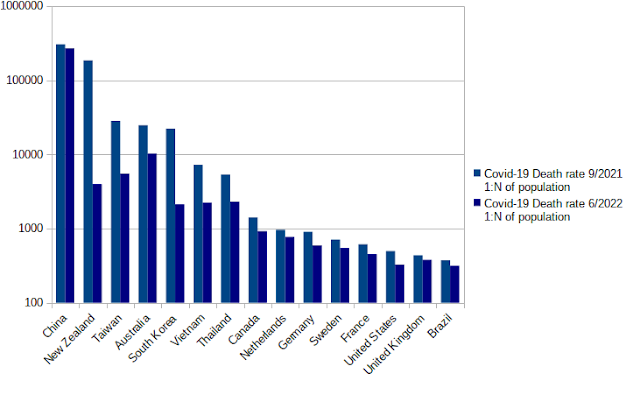
New Zealand's fall from grace is spectacular with a two orders of magnitude worse outcome now in comparison with nine months ago, the total number of deaths recorded having increased from 27 at the start of September last year to 1261 today. This rapid increase in deaths didn't take a whole nine months but actually only two, resulting from Jacinda Ardern deciding to open the country's borders to tourists from April 2022, resulting in rapid spread of Covid. I suspect that Bob Muldoon would now be impressed by Ardern, if he had lived to see this extreme example of putting business ahead of public health. Similar public health policy failures have resulted in similar results in Taiwan which went from 837 deaths to 4280 and South Korea which went from 2327 to 24388 over a similar period.

These countries once had a huge advantage over European and American nations which never bothered to protect their citizens but now it has almost entirely been squandered. China is the only country which now seems to be fully committed to protecting its population from disease, and especially the multitudinous long term consequences for health which are becoming known as long covid.

Friday, 7 June 2019

This Week in 1992. A thirty year old time capsule demonstrates both the problems due to cars and the lack of progress that we've made in addressing them.

This TV programme was transmitted in the UK in 1992. That's 27 years ago. I'm fairly sure that I watched the programme as I would certainly have been interested in this subject at that time. None of the the problems shown in this nearly 30 year old video have really been resolved. Many of the proposed solutions remain the same but they've not been implemented. It's another story of missing opportunities resulting in the problems only getting worse:


Points of interest:
  • Cambridge, like most cities, had a problem with car traffic in the city centre. They "solved" this by banning not only cars but also bicycles from some central streets. The bicycle ban was the reason why many of us who took part in protest cycle rides around that time. It was also the catalyst for the formation of the Cambridge Cycling Campaign. The bicycle ban has still not been overturned on the city centre streets so cyclists are still forced to make their journeys on less direct roads which were made more unsafe by heavier traffic due to the cars routed around the central streets.
  • When the video was made, there were already 23 million cars in the UK. A doubling was predicted to occur within 30 years. The last date for which Wikipedia has data is 2016 and by then there were 38.9 million cars on the UK's roads. i.e. up to 2016 the rate of increase was actually somewhat ahead of the prediction in the film (23*2*24/30 = 36.8).
  • Climate change effects due to cars are covered. Because the number of cars has doubled this is  twice the problem now that it was then.
  • Electric cars are suggested as a solution though the presenter points out that they could of course never solve the problem of congestion and that the emissions are mostly just pushed to power stations. We now know that total emissions of electric cars are comparable with those of internal combustion engine (petrol/diesel) cars. But even if that were not the case, adding a tiny number of them to a near doubling of the total fleet (all of which were sold as "green") they would have had no effect next to the near doubling of total emissions due to the growth in use of IC engine vehicles. This is why total emissions have also almost doubled.
  • Local pollution due to cars is seen as a problem. Many cars still ran on leaded fuel when the film was made and few had catalytic converters. These two changes to cars resulted in genuine reductions to health problems due to local exhaust emissions. However, particulate pollution always came in large part from the tyres and brakes. A doubling of the number of cars will have resulted in a doubling of this type of local pollution.
  • A traffic jam near Amsterdam. This is from a recent TV
    program about trying to solve the problem of traffic jams.
    Cars remain a huge problem in the Netherlands.
  • Amsterdam had supposedly "virtually banned" cars, with a policy of reducing car parking spaces which has echoes 27 years later as much the same thing is being done now, again to much fanfare elsewhere. I try to resist hype on this blog. The Netherlands genuinely has taken some steps to make life without a car easier. It's possible to cycle without many interactions with cars. However much more money is spent on improving conditions for driving and very little has been done to arrest the popularity of cars. Dutch commutes are the longest on average in Europe and many people find themselves pushed into car ownership to get to work. What's more, many Dutch employers pay their employees a tax free compensation per km travelled which with an economical car can make commuting so far as possible by car profitable. As a result, Dutch car ownership has grown at a very similar rate to the UK. The Netherlands had 373 cars per thousand people in 1992 while the UK had 360 per thousand. This has now grown to 556 per 1000 in the Netherlands (2015) vs. 579 per 1000 in the UK (2016). Similar growth can be seen in all countries across the world.
  • Business owners in all countries where restrictions on cars are proposed have always worried that their customers will disappear if motor traffic is reduced. It is never actually a problem. Through traffic makes streets look busy, but drivers anxious to get to somewhere else rarely stop to browse around shops while traffic jams can make it impossible for customers to reach their shops. Motor traffic free city centre streets make for a far better shopping experience. The Dutch hotel manager who fears that Amsterdam will "become a kind of Disneyland" where "most economic activity will have disappeared" can now reflect back on years of growth in tourism in Amsterdam since that time, resulting in a problem which is quite the opposite of his prediction.
  • Luud Schimmelpennink demonstrates a velomobile in Amsterdam. Velomobiles are genuinely zero emission 365 day per year vehicles which maximise the potential of human power. They fit well both into human scale cities and make the option of cycling into a viable proposition over longer distances in all weather. Unfortunately, this genuinely innovative transport mode still receives no government support anywhere, not in the Netherlands where they remain a small minority mode even though we have more velomobiles and more manufacturers of them than any other country. Schimmelpennink is better known for other innovations such as his involvement in the famous white bicycle scheme of Amsterdam and the WitKar shared electric car system from the 1970s.
  • Finally, the last man interviewed laments that it takes him up to two hours to drive five miles in London and he wonders why he has a car. Five miles, 7.5 km, is an ideal cycle commuting distance and even at a relaxed pace this distance can be covered in half an hour by bicycle. But sadly the majority of London remains an unpleasant place to ride a bicycle even now, so many people find themselves as reluctant drivers because for them this is the least bad option.
Progress ? What progress ?
This video shows how not addressing the problems of the present simply results in them becoming larger problems in the future. If we don't learn from the problems of the past then we will repeat them. And repeat them. And repeat them.

The problems due to cars have become larger in the last thirty years, not smaller.

While it's very nice indeed to see positive developments, it's important not to pat ourselves on the back too hard when the overall direction isn't actually what we wish it was.

The number of cars on British Roads over time. While there was a slight reduction in growth coinciding with the 2008 recession and its aftermath, the previous rate of growth was continued from about 2013 onwards. The longer trend (the small insert) shows a nearly straigt line with a barely perceptible bump for the 1970s oil crises and slightly larger ones for recessions. Source: UK Department for Transport.
More examples
See also how the same problems were seen in the UK forty and fifty years ago and in New Zealand fifty years ago, but they weren't addressed then either. The Dutch provided a video blueprint 30 years ago, which was ignored everywhere else, but of course even these policies didn't prevent greatly increased car usage in the Netherlands.

Friday, 18 March 2016

Making driving more convenient: Assen's FlorijnAs project attempts to reverse decades of improvements for cyclists.

Readers will have noticed that my blogging slowed down somewhat in 2015 and has not really picked up again this year so far. There are a number of reasons why, but the main reason for blogging less is that there is less good news for cyclists in Assen and across the Netherlands in general now than was the case eight years ago when this blog started. The good ideas have mostly been documented on this blog - see past posts (in the section on the right). This blog post describes a large scheme in Assen which is damaging the city, but please do read to the bottom as there's a long way still to fall.


Traffic in Assen in May 1979. Many readers will see similarities between this film and the appearance of their own city. I certainly see similarities between the film and British cities. Before and after images of some of the same locations can be found here and here.

As the danger of cycling increased, people cycled less. 1978
was the year when things finally turned around, infrastructure
started to improve safety and people started cycling more.
There is no support for the fictional "safety in numbers" idea
in this data. The much lower cycling modal share of the more
recent period compared with the 1950s and 60s and the
continued decline in injuries against relatively little
cycling growth during the 80s and onwards is the direct result
of infrastructure separating cyclists from motor vehicles
In most countries, bicycles reached their peak in the first half of the 20th century before being pushed aside in the second half of the 20th century. The year in which the Dutch cycled the least was one year before the film above was shot:1978. Why had cycling become less attractive ? Because policies which favoured cars had resulted in Dutch roads being clogged with motor vehicles. I think the film illustrates the answer very well. Cycling conditions were unpleasant because cyclists were only rarely separated from motor traffic.

The resulting conditions not only made cycling unpleasant due to low subjective safety scaring people away from cycling, but also led to the highest number of deaths per km travelled by bike that was ever recorded in the Netherlands.

The "Visie Aantrekkelijke
binnenstad 2030" from 2011
promised an increasingly
Autoluwe future for Assen,
but that's not the direction
we're heading in.
Dutch cities belonged to drivers in the 1970s. A policy change resulted in a second revolution on Dutch city centre streets which reversed this. The rest is history: City centres were returned to cyclists and pedestrians, and because the rest of the country was covered by a comprehensive grid of safe cycling infrastructure this enabled safe access to the city centre, even by children riding their own bikes.

It was only by implementing policies which prioritized cycling and deliberately improved the safety of cyclists that conditions in Dutch cities were changed from the unpleasant scenes seen in the film above. There are twice as many cars in the Netherlands now as there were when the film above was made, but cycling is far more pleasant and far safer these days than it was then.

However this doesn't mean the battle was won and that everything is going well. In fact, some of the lessons of the 1970s and 1980s are now being ignored in the Netherlands. New infrastructure which makes cycling less convenient and less safe is now being built.

Local paper: Parking garages are now
full due to the change in policy.
But who benefits from this ?
The FlorijnAs project in Assen is changing a lot of the infrastructure in the city in an adverse way. It's difficult to find anything positive at all about this project.

But the income from the
parking has fallen because
many drivers only use the
free supermarket parking
tickets (short term)
Last year's change in car parking policy has also led to problems for cyclists (I predicted this last year). Removing the out-of-town-center free parking and replacing it with half price (€6 for the whole day) inner city parking has, you won't be surprised to read, led to far more cars being along the inner ring road and into the inner city.

The increased parking in the centre has not benefitted the council because while the car parks and roads leading to them are now busier than they were, the total income from car parking has actually dropped by €100K per year as a result of the new policy. It also doesn't benefit shop-keepers because now that drivers use only the free tickets from the supermarkets to quickly do their shopping, they don't wander around to other shops and spend money there as well. The out of centre free parking used to enable this. Of course this policy which brings more cars to the city centre certainly doesn't help cyclists.

To add to the woes of the businesses in the centre of Assen, the council is supporting the building of an outlet centre on the outskirts of the city which of course will offer free parking and will help to ensure that out-of-towners use Assen's shops even less than now.

Below you'll find examples of how access to the city centre has been compromised from several directions:

From the North

The Molenbrug provides part of a main route to the city centre for people from the North-East. The narrowing of the bridge had already taken place when I wrote about this bridge last year, but at that time we still had a traffic light to stop cars. Now that the traffic light has gone as well, cyclists have less priority and worse safety than in the past. The removal of separate pedestrian facilities here also means that at busy times this bridge demonstrates all the problems which come from shared pedestrian and bicycle facilities.

The most dangerous junctions in Assen are uncontrolled crossings. One of them is further along this route to the North West and caused a fatality in 2009.

Read more about how the Molenbrug used to be.

From the North-East
Assen's roundabouts are all of a particularly safe design except for the two new roundabouts which resulted from the FlorijnAs project. These use an inferior design without a central waiting area which makes them dangerous for cyclists to cross. How did Assen lose the ability to construct safe roundabouts ? In this case, the new roundabout has replaced what was a direct priority non-stop through route for cyclists so this also causes an extra delay on a busy cycling route.
This road is being doubled in width. For motorists there will be two lanes in each direction plus a wide verge in the centre with attractive trees and a new row of car parking spaces which can be seen on the left of this picture. For cyclists, the new scheme brings the cycle-path on the left which is being built a fraction under the supposed minimum width of 3 m (which is actually too narrow for convenience).
Cycling infrastructure should support side-by-side cycling because this makes cycling more sociable and more attractive. This path is on one of the busiest routes in Assen but at under three metres wide this has been built too narrow for side-by-side cyclists going in both directions, too narrow for safe overtaking. and the lamp-posts are ludicrously close to the path itself. To the right, six lanes for drivers (one parking + two driving lanes + a verge + two driving lanes), all of which are wider than the cycle-path.
Jan Fabriciusstraat provides access from the East to the city centre. This very wide and busy road has space for multiple vehicle lanes, a grass verge in the centre for much of its length and pavements (sidewalks) of up to 10 m in width, yet cyclists have nothing but a 1.3 m wide on-road cycle-lane which is magnetically attractive for parking trucks. This is an example of wide pavement syndrome.


Also Jan Fabriciusstraat. Cyclists turning left have
to make a 130 degree turn on a very narrow path.
Where parking is provided, it is parallel to and right next to the cycle-lane, placing cyclists in danger from drivers who are concentrating on parking. The cyclists in the second photo who are heading in the wrong direction are children on the way to school. They are riding in this way because the planner of this street somehow couldn't find any way to enable a safe and convenient journey to be made by bike from the road next to the tall building on the left to the position where I am standing. Note that where the woman in red is standing there was once a wide good quality cycle-path which was removed when this street was redeveloped.

Read more about Jan Fabriciusstraat

From the East
Assen's railway station, built in 1989, is currently being demolished to make room for a new building. Most cyclists and most drivers in the station area do not have the railway station as their destination but are passing through, so direct through routes are important for both cyclists and drivers.

This video shows the direct routes South to North and East to West which existed across the station area at the beginning of 2015. They're old-fashioned, but efficient. The East-West route dumped cyclists into Stationstraat, a road which was also used by busses, but it was a wide road and unpleasant overtaking events were rare.

The new station plans include a tunnel so that drivers will benefit from an improved direct through route past the station. Cyclists making through journeys have their route made less direct and have to "share" a pedestrian area. Those heading East to West will then have to "share" a newly narrowed road with busses. Also note that for cyclists the infrastructure of the future is built of bumpy tiles, not of smooth asphalt.

The architect's impression of the new station. This is a road which will be used by taxis and busses en-masse. Anyone dropping off a train or bus passenger by car will do that right here in the middle of the picture in this shared space. Cyclists will have to make their way through this.

According to the architect, people will bring cats to the station. I suspect this will never actually happen in practice.
Update February 2019: The railway station has some of the problems described above. There is some conflict with people using the underground cycle-parking and those travelling through the tunnel by bike. However overall I think this has actually worked out quite well. Read a new blog post about the railway station.

South East

South East: Zuidersingel (which leads into Oostersingel) was narrowed and resurfaced in 2013 as part of the works which gave us the unpleasant Kerkplein shared space. The result of this work is that cyclists now find themselves used as mobile traffic calming devices. As I type this, the Zuidersingel layout is already being copied around the corner in Stationstraat as part of the new station development. As a result, the problems for cyclists which already exist in Zuidersingel/Oostersingel will also be seen in Stationstraat which is part of the main route to the city centre for most people who live in the East of Assen. It seems to be taking an awfully long tome for people to realise that "sharing" really doesn't work on busy through routes.

South
The Kerkplein Shared Space already serves as a barrier for people from the South who wish to enter the centre of Assen. With the new parking regime, the amount of traffic here has grown and with the extra traffic the unpleasantness of trying to negotiate this junction has also grown. Read more about the Kerkplein.
West
Luckily, redevelopment of some routes directly from the west into the centre of Assen occurred slightly before the FlorijnAs project started and therefore these routes were not in line to be redeveloped. However, they do lead into the areas of De Nieuwe Kolk and the Kerkplein, both of which cause issues for cyclists. Also there is one route from slightly North of West - which as it happens is our most direct route to the city centre, which is being disrupted. The existing primary cycle-route alongside the northern bank of Het Kanaal has been downgraded to a shared use secondary route and the well used footpath alongside has been made unusable to many people by the addition of steps
Constant conflict with pedestrians because while there is a separate pedestrian path, that path is so badly designed (it's down some steps by the water) that almost no pedestrians use it.
Because the corner radii are far too small, people have made their own path which after a few months already looked nearly as permanent as the real path. This is an indicator of badly designed / not fit for purpose infrastructure.
The replacement primary route is on the other side of the canal. Yes, it initially looks OK. However, the details are all wrong. Why have cyclists been short-changed in width once again on a primary cycling route when there is so much space available ? Why has the cycle-path been positioned so close to the road and so close to lamp posts ? Why is there a loading bay on the wrong side of the cycle-path when the empty shop which it is next to has its loading bay in a car park on the other side ? There is no reason to expect large numbers of pedestrians here so the pavement is overly generous.
Further along the same path cyclists have to give way twice to car park entrances. No priority on a primary cycling route. The old primary route on the other side of the canal worked better than this. Watch a video which shows what remains of the old route, which has been given a rougher surface than in the past.
What future for Assen ?
I am quite aware that some readers will look at the photos and videos above and wish that they had the same problems as Assen does. Clearly none of the problems shown above quite take us back to how the Netherlands looked in the 1970s. However, they all illustrate new problems which are being created for cyclists in this city due to cycling just not mattering very much to planners and motoring being given a higher priority. If this process continues then it could easily lead to a slow slide downwards in the cycling modal share. People don't have to experience much unpleasantness when cycling to make them give up.

Infrastructure which was built 5-10 years ago was of a higher quality than what is being built now. There is no good reason for this. Certainly not a financial reason as FlorijnAs is an astonishingly well funded project which has a total of €1.5 Billion to spend. The high level of funding combined with any downward change in quality is a serious concern as the extensive works of FlorijnAs will affect all cyclists in Assen and they already put the city back a small step so far as cycling is concerned.

I'm not very concerned as FlorijnAs isn't all of Assen and this still remains a city which overall is lucky enough to have amongst the very best infrastructure in the world. A few small steps backwards won't make a huge difference so long as the ambition to improve is found again.

As I understand it, Assen's previously stated ambition to grow cycling still stands. If this is more than mere words then the city needs to do better than what is shown above to retain present and encourage future cyclists.

What future for other cities ?
One of the problems with writing about the less good developments in this city is that some readers gain an impression that it is only Assen which is making mistakes. That is of course not true - it's just that I'm an trying to give an honest appraisal of the place where I live and there are not so many people doing this. Positive stories abound, including about things which are really not very good at all.


It's really not just Assen. This publicity shot from Groningen,
headed "further improvements in cycle facilties" not only
lavishes praise on horribly outdated advanced stop lines (bike
 boxes) but also uses a photo of the most dangerous single
street in the city 
as an aspirational image. I nearly fell from
my chair when I read this... Not what you want to emulate.
There is nothing uniquely Assen about any of  the problems illustrated above. The architects and planners who designed the infrastructure illustrated above also work elsewhere and they are doing pretty much exactly the same thing in several other cities while other planners and architects are making other mistakes here and elsewhere. It's quite normal that ideas wax and wane in popularity. In the Netherlands at the moment, cycling is not the big thing which politicians are trying to improve. For that reason we should not be surprised that this period of time doesn't bring the best improvements for cyclists.

However it is important that the attitudes change before too much harm is done. Keep going backwards at this rate and in forty years time the Netherlands will once again look as it did in the 1970s.

Study Tours
Yes, there are study tours again this year. While this blog post points out problems within Assen, this is still a city choc full of good examples. We also visit Groningen, which like any city is also a mix of good and bad and has plenty of its own problems. The majority of both cities work well and this is reflected in the high cycling modal shares. In any case, looking at problem areas gives us an opportunity to demonstrate how what might be seen as rather small issues ("wish I had that problem") actually really are important if a truly high cycling modal share is your aim.

There are still some places available on the April tour, but you will have to be quick to book. Similarly, there are also still places available on the May follow-up tour (contact us for details) on which we demonstrate what changed since your previous study tour.

Our service is to demonstrate what is good and also show what works less well so that participants know what should not be emulated. It's important to bear in mind that not everything Dutch is good. From every period there are both very good examples and also some poor examples. We have nothing to gain from implying that any infrastructure which is less than excellent works well enough and you can rest assured that we do not gloss over problems. I hope that the above blog post makes that clear.